I have been working for the Office of the National Coordinator for Health Information Technology (
ONC), on the
popHealth and
Cypress projects for several years now. Both projects are based around Clinical Quality Measures (
CQMs).
By education, I am a physicist and engineer, and not a clinician. However, I have repeatedly noticed the importance of
lipid profiles within the context of the logic of several of the
Meaningful Use CQMs. Further, in the very recent past, these metrics had been considerably high for me; a male in my late 30's. Between my work looking at CQMs emphasizing the importance of just measuring lipid profiles, and my own personal warning signs associated with this health metric, I thought it would be good to collect some "hands on" experiences with the collection of the data for this metric.
When my department at
MITRE had some additional overhead resources available at the end of our fiscal year, I purchased a portable blood testing device that could provide me with my own lipoid profile information (
total cholesterol,
HDL cholesterol,
LDL cholesterol, and
triglycerides).
I eventually picked the
CardioChek PA blood meter device. Interestingly, this was not the first CardioChek blood device that I purchased. I originally found the consumer CardioChek (no "PA")
device on Amazon.com. The
consumer device lists at about $125. That seemed reasonable, but the device requires
three separate strips to measure total cholesterol, HDL cholesterol, and triglycerides (you can calculate the LDL cholesterol from those three). While that may not sound bad, I quickly found out that it involved giving myself at least two, sometimes three, pricks with
lancets to draw enough blood for the three separate tests.
Additionally, I purchased this device for my department at work, and felt that an experience getting three pokes with a needle might not go over well with my colleagues, resulting in some future retribution via
office pranks.
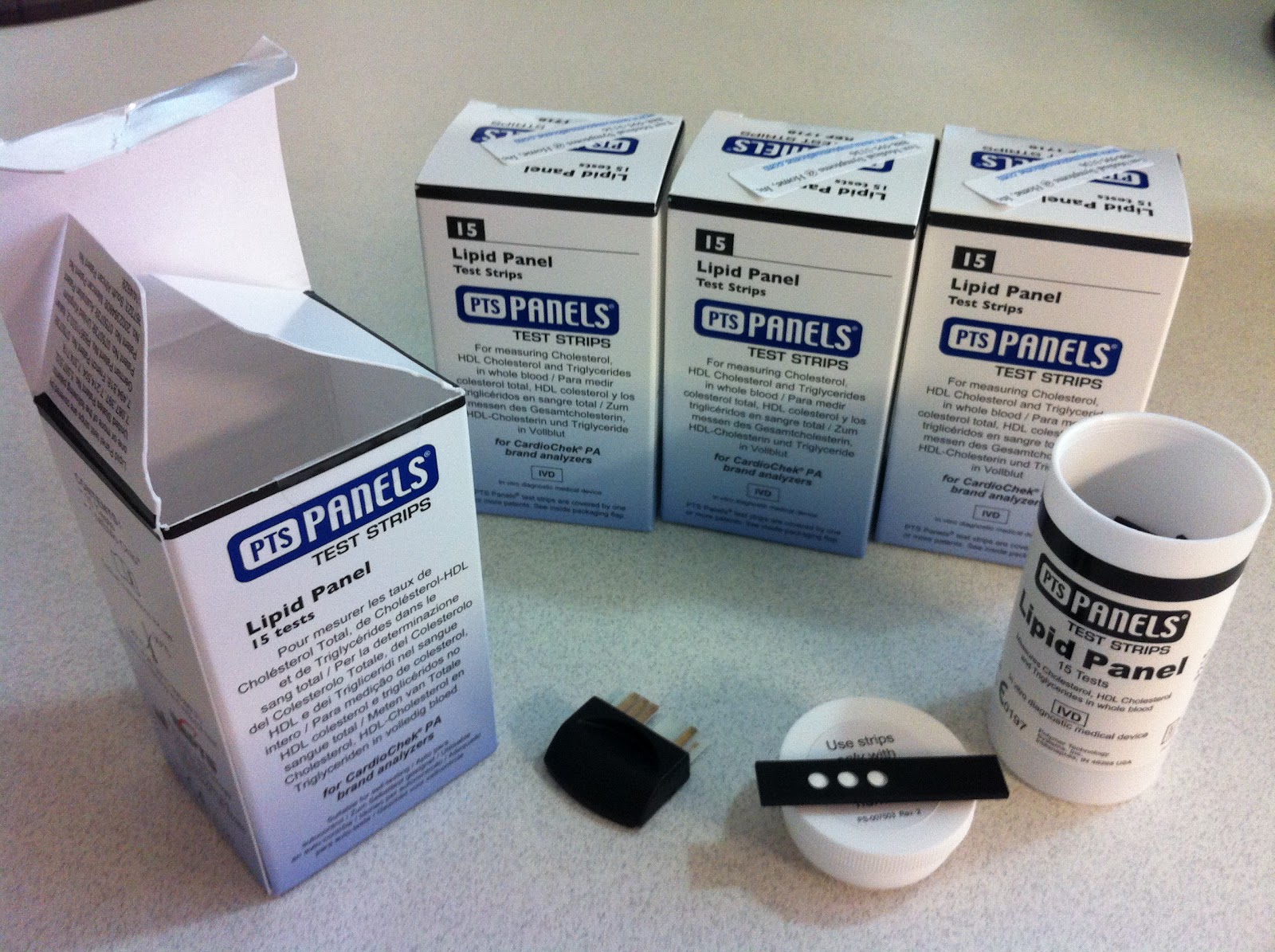
To solve the problem of collecting a full lipoid panel from one drop of blood, I purchased these PTS panels that appeared nice in the sense that they have the ability to drive the calculation of multiple readings from a single sample of blood.
 |
Each box comes with one lipid panel MEMo chip that can be inserted
into a CardioChek PA device and 15 single use lipid profile panels |
Unfortunately, I quickly discovered that these really nice 3-in-1 lipid profile panels are
not compatible with the $125 consumer CardioChek device. To support multiple readings from a single drop of blood would require the more expense
CardioChek PA device, that runs at close to $700.
Being the end of the fiscal year, the additional money was a little easy to come by. I went back to our finance staff and purchased the more expensive, clinical-grade device. I also picked up some supporting medical equipment like
gloves,
lancets,
pipettes, and
band aids.
 |
CardioChek PA blood testing device, several tests
with some additional medical equipment |
To take your lipid profile, you need one lipid panel test chip, called a MEMo Chip by the manufacturer, and one lipid panel test strip. The MEMo chip contains lot-specific calibration and other information needed to properly perform testing. The lot-specific information is presumably associated with the 15 test panels that come with the package. I would not recommend mixing and matching test panels with different MEMo chips, because of this prior calibration by the manufacturer.
There is also guidance around always storing the unused test panels at a temperature between 68-80˚F. I could see this temperature requirement as a challenge for some home/consumer users. Lastly, there is an expiration date on the test panels. For all the tests I have, the expiration date, is less than one year from now, a little under 8 months of viable shelf time.
You can see the relative size of the test panel and MEMo chip in the picture below. You only need one strip for a test. I just flipped one test strip over to show the single wide channel where you deposit your blood, and the three openings for the device sensor to read the total cholesterol, HDL cholesterol, and triglycerides.
 |
| Lipoid panel test chip and two lipoid panel test strips |
It appears that the CardioChek PA device has the ability to independently test up to four different metrics from the single sample of blood. While I haven't found any tests that use a full four metrics from one sample, I am still happy that the manufacturer (presumably) recognized this need for multiple tests from a single sample.
 |
| CardioChek PA sensor |
Collecting and depositing your sample for the device is relatively easy for an individual, non-clinician. I suggest you get 2 paper towels, and a small band aid before you get started. If you are unfamiliar with using lancets, they are small and cheap medical implements used for capillary blood sampling (no vein or arties). A lancet includes a spring-loaded needle. When used, it pops out and makes a very small puncture in your skin, allowing a few drops of blood to appear on your skin over the next ~10 seconds. They are single use and disposable.
You can see how they are fairly straight-forward to use for the blood sampling that you can then collect with pipettes.
 |
| Lancet |
 |
About one drop of blood after lancet met my finger
with small pipette in background |
After my first two attempts to use the device for a full lipid profile, the device would eventually display "TEST ERROR" on the screen. Needless to say, I was disappointed to think that I had put over $1K into this exercise, and had no data to show. As it turns out, my finger was not providing enough blood to generate the full lipid profile. There is some documentation provided with the device that makes this association from the "TEST ERROR" message. However, I just can't understand why the manufacturer didn't make this more intuitive for users.
On my third attempt, when I applied a liberal amount of blood on the sample channel, the device worked fine. I feel that the accuracy of the device is very high. The readings it provided were all within 10% of measurements that I had collected from my Primary Care Provider (PCP) the previous week. For me, the time between depositing your blood on the strip until the results are displayed ranged from 40 to around 60 seconds on three test runs.
This problem that resulted in multiple "pokes" with the lancet makes for an amusing story at my expense. However, I can't emphasize enough; the "TEST ERROR" message really means "Not enough blood". This is an opportunity for improvement in this product for first time users.
On this topic of human-computer interaction, I was also disappointed with the CardioChek PA user interface. For $700, the interface feels like bleeding-edge
late 1980s technology.
 |
| CardioChek PA user interface |
For a $700 device, I would think that the manufacturer could easily upgrade the resolution and include color at a modest increase in manufacturing costs. Ideally, this would include some
longitudinal data on changes associated with the data. See my suggested illustration below, again based on
Juhan Sonin's designs for a
HealthCard for the patient (consumer).
 |
| My updated lipid profile with sparkline visualizations |
On the positive side, the CardioCheck PA is worth purchasing if you think you will be frequently taking your lipid profile at home. It appears very accurate on the measurement results. Once you learn the interface and how to correctly provide enough of a blood sample, the device works well.
My biggest issue with this product is the variance in the cost of the CardioChek PA device at $700, versus a slightly more limited consumer CardioChek device at $125. I feel that this
price point makes the CardioChek cost-prohibitive for most consumers (patients).
I would grade the CardioChek PA device a
B- for the purposes of home users.
Somewhat related to where this may go in 5-10 years, I was able to identify an amazing illustration, showing various ranges for numerous blood metrics:
Knowing that a single drop of blood could theoretically yield all these metrics makes for some interesting ideas about how the consumer could have access to these metrics on a daily basis, at their home.
Another interesting opportunity for this market would be to introduce a blood sensor without the embedded interface that could communicate with an iPhone, similar to how the
Withings BP Cuff works. I have that Withings device at home, and plan on developing a review of that device later.
This work is licensed under a Creative Commons Attribution-NonCommercial-NoDerivs 3.0 Unported License. © Rob McCready, 2012.